


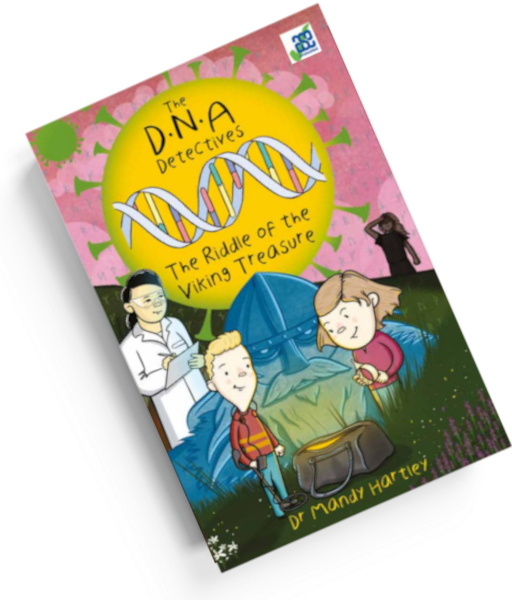
The DNA Detectives – The Riddle of the Viking Treasure
£6.99
Suitable For:



“The DNA Detectives – The Riddle of the Viking Treasure” is the fourth book in the “DNA Detectives” series. It is suitable for children aged 7 – 14yrs (KS1, KS2 & KS3). The story is based on a famous five style adventure where the characters use DNA and clues provided by plants, pollen and soil collected from the evidence to solve a crime. In addition to the exciting storyline readers will learn about DNA, cells, forensic science, forensic ecology, plants, habitats, Covid, viruses, vaccines and the history of the Vikings.
Are you ready to join Annabelle and Harry, The DNA Detectives, in their new adventure, The Riddle of the Viking Treasure? This new case is set in the Covid-19 pandemic lockdown. During a family kayaking trip, Harry falls into the river and has to swim to the bank. It is there that he makes an exciting discovery, a gold sword! He realises he has found one of the valuable Viking artefacts which have been stolen from the Castle Museum. Where is the rest of the treasure? Why has it been stolen? Who is the thief? The key to solving the crime is the evidence from soil, plants, and pollen found at the crime scene. Can Annabelle and Harry, the Forensic Ecologist, and soil scientists analyse these clues and identify where the artefacts are buried and who buried them? Join The DNA Detectives, our Forensic Scientists in the making, on yet another page-turning, exciting mystery.
I am delighted that this book has been reviewed and awarded a “Green tick” from the Association for Science Education. This is what they had to say;
How the book supports the curriculum
There are obvious links to Plants topics within the science curriculum through sections that describe flowers, wind and insect pollination and the role of light and chlorophyll in photosynthesis. This enriches and extends learning identified in the English National Curriculum and introduces science traditionally covered at Key Stage 3 (ages 11-14). Importantly, it is done in an engaging but accurate way. Similarly, learning within the Rocks topic can be enriched with descriptions of chalk and microfossils, and how chalk formed in warm shallow seas.
There are good links too to the history curriculum, through descriptions of Viking raids into Anglo-Saxon territory, and wider-scale invasions and how this led to Danelaw. The Anglo-Saxon Chronicle is mentioned as one of the sources of knowledge about this period, making a nice link to how evidence is used to determine events in history. Viking beliefs and folklore about Valhalla and death are neatly woven into the story and provide additional interest for children. Many secondary-age readers will have seen the Marvel Universe Thor films and will likely enjoy finding out more about real Vikings. This section also nicely identifies influences that the Vikings had on our language and place names.
Writing The Book
“The DNA Detectives – The Riddle of the Viking Treasure” is my fourth book. Just like my other books the story has been in my head for a very long time! I wanted to write something for children that would bring the subject of the Vikings alive. It is such a fantastic subject and the history of the Vikings from the first invasions is a fascinating one. I also wanted to introduce them to the amazing world of Forensic Ecology, where scientists use clues from the pollen, soil and plants in the natural habitats around us to solve crimes.
Finally, I wanted this story to be set during the lockdown. Although it was a difficult time for many of us, it is an important event in children’s lives. Writing this book was an opportunity through the story, to help explain some of the science behind the epidemic, including the introduction of the vaccine which helped us get out of it.
For many people lockdown and the Covid-19 pandemic was a time of isolation, not going into school, and staying at home. We didn’t get to see our friends and close family. I was ill with Covid at the start of the pandemic. While I was recovering, I started thinking about how you could catch a criminal in a lockdown. Would it be easier or harder? This was how the story for The DNA Detectives The Riddle of the Viking Treasure came about.
I spent a lot of time during lockdown reading. I read two incredible books, Traces by Patricia Wiltshire, and Murder most Florid by Dr Mark Spencer. In these books Patricia and Mark talk about their experiences working as a Forensic Botanist/ Ecologist. Clues in a natural habitat can be left at a crime scene by a suspect, or transferred from a crime scene to a suspect, or items used by a suspect. These clues come in the form of plants, pollen, fungi spores, even soil. They can be used as evidence to prove if a suspect was at a crime scene and to determine whether a suspect is guilty of committing the crime which happened there.
In my previous stories, Annabelle and Harry have become forensic scientists and collected clues from DNA evidence left at a crime scene. After reading these books I thought, as well as collecting DNA evidence, it would be exciting in this story to have them taking on the role of a Forensic Botanist/Ecologist, just like Patricia and Mark. You will be amazed as you read the story to find out just how many clues can be collected from the natural world which can help to solve a crime. The question is will it be enough to solve this case?
Finally, I was looking for a period from history to include in the book. I have always wanted to write about the Vikings, as I think they are so interesting to learn about. I am very lucky that East Anglia, where I live, was somewhere the Vikings spent a lot of time. We know this because of the evidence they left behind. Many exciting Viking artefacts have been discovered locally. A lot of these artefacts weren’t found by archaeologists but people using metal detectors in the local fields. Imagine hearing a beep on your metal detector, digging in the ground, and discovering a stash of coins, a sword, or gold jewellery! I went to see some of the items which have been found at The Ancient House Museum, in Thetford. They had a special exhibition when I was writing the book! It was wonderful to see Viking swords, brooches, rings, and Thors Hammers up close. You get a real idea of their size and beauty. It was amazing how well preserved they were considering how long they had been hidden in the soil.
Interestingly, scientists studying DNA from people living in the United Kingdom today estimate that 6% of us will have Viking DNA. In fact, when I had my DNA analysed to see where my ancestors came from, it came back as having Scandinavian links. I like to think that I might be part Viking, maybe you are too!
It was such a pleasure to write this book and I hope you will learn a lot by reading it. I certainly enjoyed adding this new forensic skill to Annabelle and Harry’s DNA Detective toolbox! Will you be able to solve The Riddle of the Viking Treasure by solving the clues? I hope so. It might inspire you to become a Forensic Botanist, or maybe to carry out research that might help us fight off any future pandemics. That would be amazing! Happy reading, everyone.
Weblinks
I have compiled some great web links to help you learn more about DNA, cells, forensic science, forensic ecology and the Vikings.
I have divided the web links into the chapters from the book so you can learn about the different subjects as you read the book. There are some great video clips to watch, podcasts to listen too, some great activities, including deciphering some Viking runes, you can go to a virtual online laboratory and try some DNA fingerprinting, find out what pollen looks like under the microscope and extract some DNA from fruit at home!


 tlstc@outlook.com
 07776396963